Close the gap between what you know and what happens when you play.
Embrace your unique brain to reduce "stupid" blunders, calculate with confidence, and finally feel clear in your Chess.

Start your journey with all my best insights.
"I can confidently say your free program has helped me far more than any chess course!"

Andy G.
USA
As Seen In



Your most painful blunders are just your adult brain doing what it's designed to do.
Research tells us our brains can hold 7 chunks of information at once. There are 32 pieces on a Chessboard.
One of those numbers is bigger than the other.
To handle the load, your brain makes compromises.
To help you keep thinking through your attack, it forgets the queenside exists. And you hang your queen to that long distance bishop.
Or it keeps putting the knight back where your eyes can see it on the board, even though you've already moved it in your calculation.
It's hard to play good Chess when you can't trust your own brain to help you.
"Aiden understands the needs of the adult improver like few others in the chess world. His empirical, cognitive-based approach makes Don't Move Until You See It the perfect resource for adults who want to understand their own brain and improve their chess."

IM John Bartholomew
YouTuber & Co-Founder of Chessable
Your best Chess takes knowledge and muscle.
Chess knowledge is vitally important. But we also need the mental muscles to notice and remember details about the position, hold sequences in our head, and avoid tunnel vision.
And those skills all fit in the most undertrained part of Chess improvement: conceptualization.
(You may know it as "visualization", but for 40% of adult players there isn't actually anything "visual" about it at all. So I use this new word instead.)
When our conceptualization muscles are weak, we hang pieces, get confused, and forget key details in the moment. We lose games not because our opponent beats us, but because our own brain fails us.
But when our conceptualization is strong, it's like a fog lifts. We feel clear. And we start to see all that knowledge we've accumulated appear on the board.
"For visualization, Don't Move Until You See It is the best there is. Aiden goes very deep into the science and knows his stuff very well."
GM Noël Studer
#1 Swiss player & founder of Next Level Chess
So how can we strengthen our Chess muscles?
We will achieve our best results when we stop expecting our conceptualization to improve while we do other things, and instead give it the direct focus that it deserves.
We need:
- targeted blindfold, semi-blindfold, and sighted exercises to force our brain to build capacity and handle the pressure and mental load of Chess with gusto.
- simple awareness habits to ensure we arm ourselves with everything each move does and feel clear as we calculate.
- a deep understanding of how our unique adult brain wants to conceptualize, and the trust and comfort to let it do its thing.
100% focused on making your adult brain better at Chess conceptualization.

Conceptualization gym and member community.
Featuring 1100+ targeted exercises, focused mini-courses, daily content releases, and a thriving community of fellow conceptualizers. This is the best way to strengthen your mental Chess muscles.
Become a Don't Move member today.
Chess Visualization with Aiden Rayner podcast.
Daily episodes to actually improve your Chess on the go. Featuring exercises, lessons, walkthroughs, and quick actionable insights.
Available wherever you get your podcasts.
Subscribe on Spotify.
One-on-one coaching.
If you want personalized, individual guidance to diagnose weaknesses, build conceptualization skills, and understand your own Chess brain, you can apply to work with me directly.
Find out more and apply.
Insightful, science-backed articles.
Weekly insights into training techniques, psychology, neuroscience, and adult learning to guide your conceptualization and adult improvement journey.
Start exploring the archives.Hi, I'm Aiden. And I'm honored you're here.
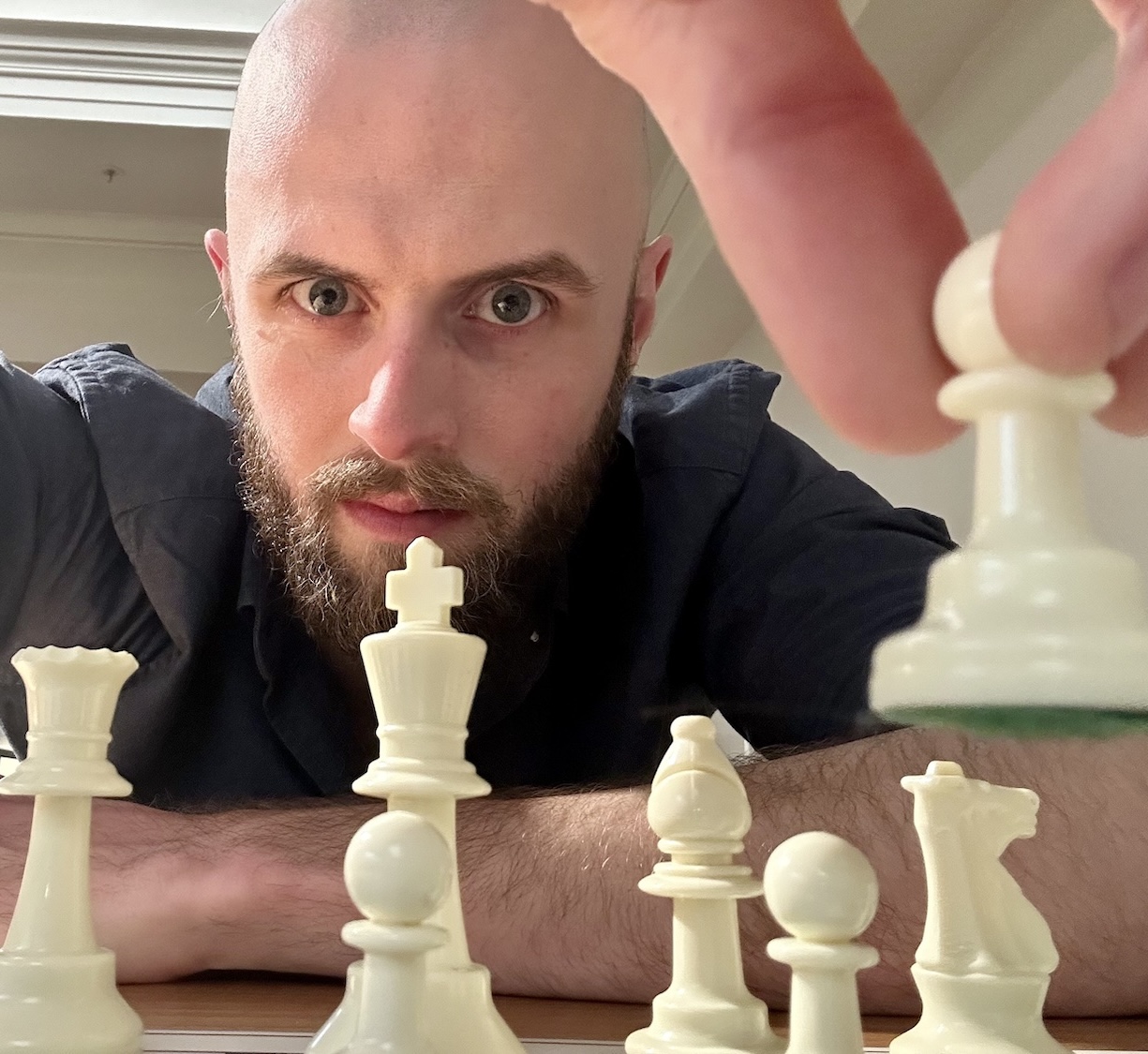
I've been deep in research on conceptualization and the adult Chess brain for half a decade now.
In that time I have taught tens of thousands of adult improvers through my articles, newsletter, and podcast. Hundreds through the Don't Move Membership. And dozens from beginner right up to IM through my one-on-one coaching.
(Hoping to coach a GM soon 🤞)
The Chess world is full of extremely talented, generous, well-meaning people who learned Chess as kids and simply don't understand what it's like to approach it as an adult for the first time.
It's my passion and my goal to help adult improvers like you fill in the gap, and to understand, embrace, and experience just how good your brain can be at Chess.
If you're curious, I wrote about my journey from total beginner to conceptualization expert here.
Frequently asked questions.
Where do I start with conceptualization training?
The best place to begin is my free 5-day Conceptualizing Chess Series. It will give you all the key background you need, and guide you through your first conceptualization exercises.
After that, my podcast and articles are free and have created plenty of improvement for adult improvers on their own. If you decide you want to go deeper, you can join us with a paid membership whenever you're ready.
What rating range is conceptualization training useful for?
I've seen strong results in everyone from 600 on Chesscom right up to titled players.
If you have an understanding of Chess fundamentals, how the pieces move, and very basic tactics and strategy (take the center, get your pieces out, etc), then you're ready to introduce conceptualization training.
How can I work conceptualization into my Chess training routine?
The most impactful thing you can do is include 10 minutes of conceptualization training at the start of each session of training or playing Chess. This both strengthens your mental muscles and gets them primed for whatever else you're going to make them do in your session.
Members have access to a dedicated daily stretch tool to guide that 10 minutes of work, but you can work through exercises on the podcast or practice with our various trainers for free as well. I go into more depth in this article.
What's your FIDE rating?
I don't have one. Several years ago I realized I had a choice between working on my own Chess or working to become the world expert in Chess visualization/conceptualization. I chose the latter and have not looked back.
I believe my half-decade of intense research and 500+ coaching hours, including with many titled players, qualifies me to teach this stuff far more than any rating or title would.
Is it possible to improve at conceptualization if I have aphantasia?
Absolutely. We've had plenty of masters throughout history, including blindfold simul record holders, who had or seem to have had aphantasia. Your brain's been handling complex information since the day you were born, and it has ways to do that. They're not visual ways, but they're every bit as valid, and will come with their own unique superpowers and kryptonite.
For more guidance on aphantasia specifically, this article is a good starting place.
Do you offer any special support for coaches/authors/content-creators?
I'm passionate about arming Chess instructors with a deep understanding of conceptualization so they can better help adult players to actually improve.
I offer free memberships for coaches, content creators, and authors, and am always happy to help in any way I can. Reach out to me and we'll get something organized.
Don't Move members have...
Reduced blunders and broken through rating plateaus.
"I just stopped hanging pieces! It was definitely unprecedented progress just adding in 15-30 minutes/day doing Don't Move. My online rating jumped 250 points in around a month."
DJ
United States
"Since finding your work I went from 1800 to 2254 on Chesscom. It has really changed my whole thinking process about chess."

Jaydeep
India
"IMPRESSIVE. I played the final of the state championship and defeated players I never imagined I could (FMs with ratings of 2200 to 2300). THANK YOU! You revolutionized my chess."

Rafael
Brazil
"This program has helped improve my chess visualization dramatically. With Don't Move, I am improving month over month."
Liam
United States
"Since joining the ‘Don’t Move Movement’, my rate of improvement is much more proportionate to the effort I'm putting put in. I think what you are doing is of such great value that I am very happy to shift my focus from ‘chess knowledge’ to ‘chess muscle’ for this year."

Adrien
United Kingdom
Found comfort and clarity in their Chess.
"It helped me understand how my brain works! Now I see the reduction of blunders and the clarity of positions while I play. There is still so much work to do, but it's outstanding how effective this training is!"

Giacomo
Italy
"I went from 1700 to 1900 rating. I saw clearer, sharper lines. I could play faster with fewer blunders."
Peter
United States
"Recently I'm noticing solutions becoming much clearer; at times, almost automatic. It's providing a method to visualize, the 'missing link' I suppose."
Mark
United States
"After about 2 months I discovered with amazement thoughts, dynamics of my brain that I had never known before while studying and playing chess. Especially appreciate being able to move pieces just with my mind"
Riccardo
Italy
"It helped me understand better the way that I process information and gave me insights into how others do as well."
Nick
United States
Achieved great results in a short time.
"I've been using Don't Move for about a week now and I'm honestly shocked how quickly I'm beginning to be able to visualize the board in my head."
Ricky
United States
"I won 17 straight games of 2+1 bullet and hit a new peak rating. Coming as it did immediately after my first session of visualization training, it's hard to right it off as a coincidence."
André
United States
"I am 1692 Lichess Classical and a week ago hadn't beaten anyone higher than myself. In the space of a week after finding you, I beat a 1777, then an 1860!"
Ric
United Kingdom
"I'm up 300 points in the past two months. I can clearly see all moves for 7 moves deep on both sides. I can learn all chess related things faster and easier now. As I have a much clearer memory, image, and story in my head."
Cory
United States
"Thank you for teaching me conceptualization! I have had a lot of fun with the exercises and already won a game completely blindfolded (with high accuracy too!). I think I might start to get addicted to blindfold chess!"

Veeti
Finland
Curious what conceptualization could do for your Chess?
I put all my best insights into one email series.
If you want to learn the underlying reasons behind your worst blunders, embrace your unique Chess brain, and get plenty of practice (20+ exercises included!)… well, here's the place to start.
There is no hard sell anywhere in this series. I believe my business will grow if I help you grow first.