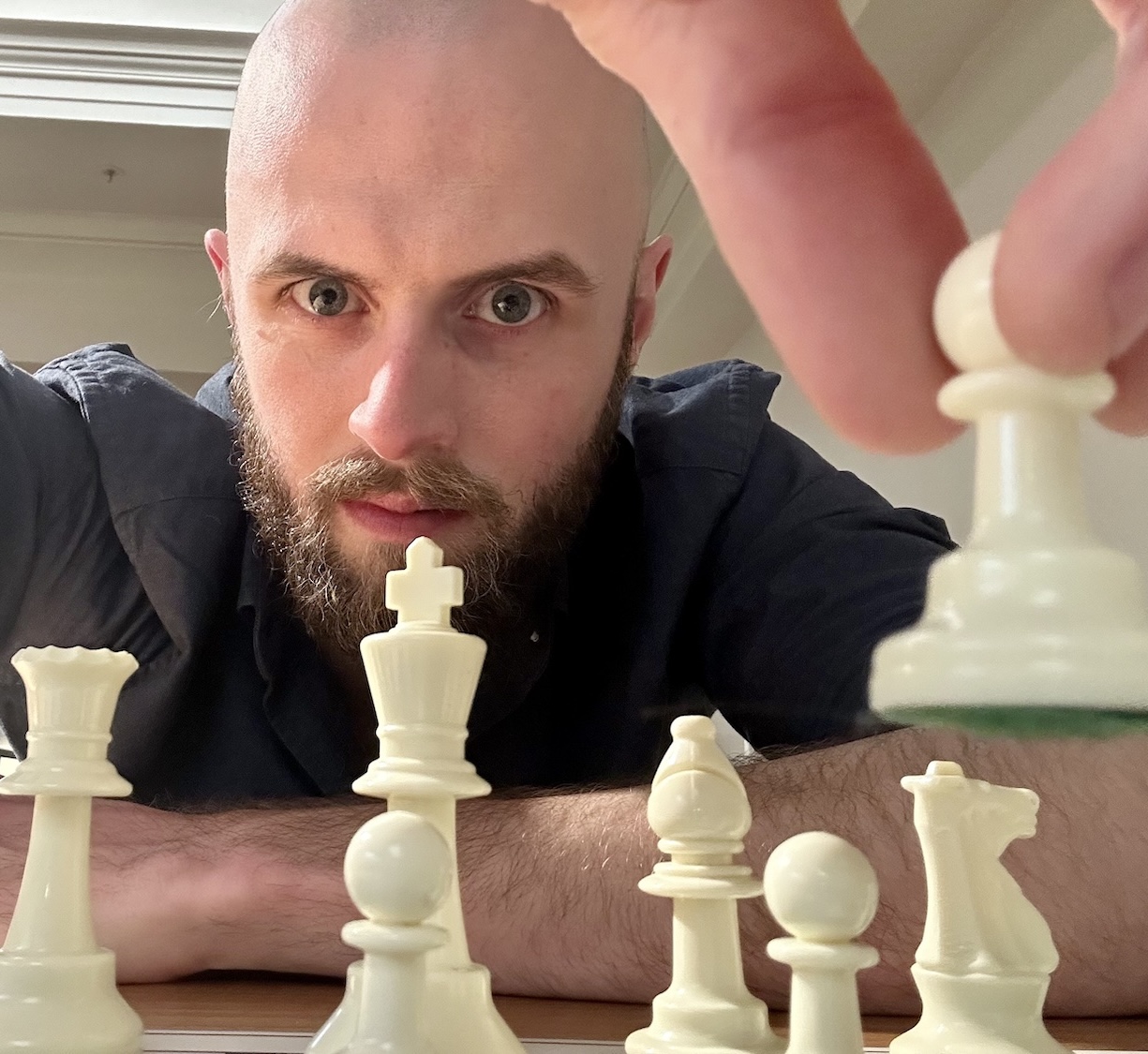
"Exhausting as it was, playing blindfold had a positive impact on my play. The strain of calculating variations in over-the-board Chess seemed a breeze compared to the rigors of keeping ten games on track without sight of the board. My [over the board] results shot up dramatically during this period."
GM Larry Christiansen
We play a surprising amount of our Chess blindfolded.
I suppose it's not exactly right to call it "blindfolded". The board is right in front of us.
Even so, many of our decisions are based on the information that we can't see.
When you consider moving a piece, you don't see the piece move first.
You think about what it would mean for the position if the piece was there instead of there.
You see the original position, but your decision is about the unseen bit. The semi-blindfold bit.
Then as you calculate further, more and more of your decision hinges on the semi-blindfold bit.
But there's a bunch of semi-blindfold information we have to juggle even before we start looking ahead.
We feel like our eyes take in the whole position as we play, but our brain experiences it as something else. Something closer to how you experience reading this article.
As you're reading this sentence, your eyes are taking in one word at a time. As you move on to the next word, the previous one merges into your working memory.
It's your working memory that allows each sentence to make sense as a whole, instead of a flow of individual unrelated words.
Your working memory is also enabling each word and sentence to feed into your sense of the article as a whole. It doesn't keep verbatim copies of the things you've read — you probably couldn't recite what you've read so far — it just keeps the gist.
The wider points, the key themes, any central motifs. This gist becomes the context to help you understand any new word or sentence you read.
Your working memory helps each word make sense by providing the context. And each word you read changes that context just a little bit. It's a two-way relationship.
The same core relationship between eyes and working memory occurs when we see a Chessboard too.
There's too much information on a Chessboard for our eyes to take it all in at once. Even if our eyes physically see the whole position, our attention moves across it chunk by chunk.
As soon as our attention leaves a chunk of the board, like moving to the next word when we read, it's down to working memory to hold the context from the other chunks.
We interpret each new chunk partly by the context our working memory holds about the wider position. And each new chunk we take in changes that context in big and small ways.
If our working memory is missing details, either because we forgot them or weren't aware of them in the first place, then those gaps affect the context of the position. That context affects our understanding of each chunk and what it means.
Our eyes and these semi-blindfold bits held in working memory are interacting all the time, informing and changing each other.
Any part of the board we don't have attention on right now is, in effect, semi-blindfold. Any moves we're calculating ahead are semi-blindfold. Much of the context we use to understand what we're looking at in a Chess position is semi-blindfold.
If it's semi-blindfold, it's down to our working memory to handle it. Which presents a problem. Our working memory isn't designed to hold all that much.
Working memory can only hold about seven pieces of information at a time. We hit that capacity very quickly in Chess.
To make matters worse, those seven slots for information aren't just for information. They're shared with a bunch of other executive functions; self-control, emotional regulation, thinking space.
So all of this semi-blindfold information we rely on is stored in a low capacity, highly volatile, short term resource, with a bunch of other more important (from an evolutionary, instinctual standpoint) functions vying for the space.
Our working memory overloads, the semi-blindfold details start to slip.
We often sense this happening. It's the feeling of fog you get when you're looking ahead, and sometimes even when you're looking at the position in front of you. Like you've hit a limit and nothing's going in anymore.
Now, elephant in the room: we're not 100% reliant on our working memory when we play. We can always flick our eyes back around the board and remind ourselves of details.
That catches some mistakes, but not all. If it caught all of them, you wouldn't be here and I'd have to find another job.
We look around the board constantly, afraid to fall victim to the dreaded tunnel vision.
We regularly find ourselves calculating a move for several minutes, just to discover it doesn't make sense because a piece on the other side of the board — that we'd forgotten about until our eyes spot it again — is covering the key square that starts the variation.
Heck, some of us use the "confirm move" feature on online platforms to let our eyes check for issues with the move we're considering before we commit to playing it, dodging the semi-blindfold part of move selection entirely.
(Side note: if you use "confirm move" I recommend you turn it off. Yes, it catches mouseslips, but most people I've seen use it to preview their move and check for blunders before they commit. You make fewer mistakes in the short term, but it's holding you back from developing the real Chess skill. Fair warning, you may dip in rating when you switch it off. But all that means is it was artificially inflating your rating in the first place.)
Our eyes do too much of the heavy lifting. We're far too reliant on them to catch us before we miss anything critical.
We want a better balance, a better handle on this semi-blindfold information. And that's difficult to achieve when our eyes can continue to (attempt to) bail our working memory out.
They're just good enough at covering for our working memory that they can prevent us really addressing these issues. They're a crutch.
If I know anything about brains, it's that they're inherently, hilariously, beautifully lazy. If they don't need to do something energy-intensive, they won't.
So if we want our working memory to get better with Chess information, the fastest way to do it is remove the crutch.
When you work through a blindfold exercise, all of the pressure lands solely on your working memory. Without the eyes to help it, it panics and it starts trying stuff.
Eventually it works out how to handle all that information. Because it has to. Your eyes aren't there to cover for it.
Then you return back to your Chess and find all that semi-blindfold information easier to navigate.
If you teach your brain to do full blindfold work, then the strain of all that semi-blindfold stuff is easy by comparison.
With time and training, we find the balance between eye and brain shift. The eyes now help the working memory out. They don't need to bail it out quite so often.
We stop forgetting the queenside exists in key moments. We pierce further into the position. Notice more. Feel the fog lift.
We calculate faster and with more confidence. Because your eyes are no longer having to drag your poor conceptualization along behind them.
That's what I've seen time and again from blindfold work and why I recommend it so fervently.
But it's at this point I need to drop a word of caution.
(This is a detail I really wish I'd worked out sooner than I did.)
We need to regularly connect our blindfold work back to our regular Chess. Show our brains that these systems it's building in blindfold situations still apply in semi-blindfold ones.
Otherwise we run the risk of our brains treating them as totally separate things.
I'll have more on that in Part 3. But for now, I recommend you start each session of Chess with 5-15 minutes of blindfold work.
Stretch and warm up those mental systems, then jump into your regular sighted Chess work. Let your brain see how those systems apply.
And, with time, feel the strain of the semi-blindfold bits fade.
Here's to the journey,
Aiden