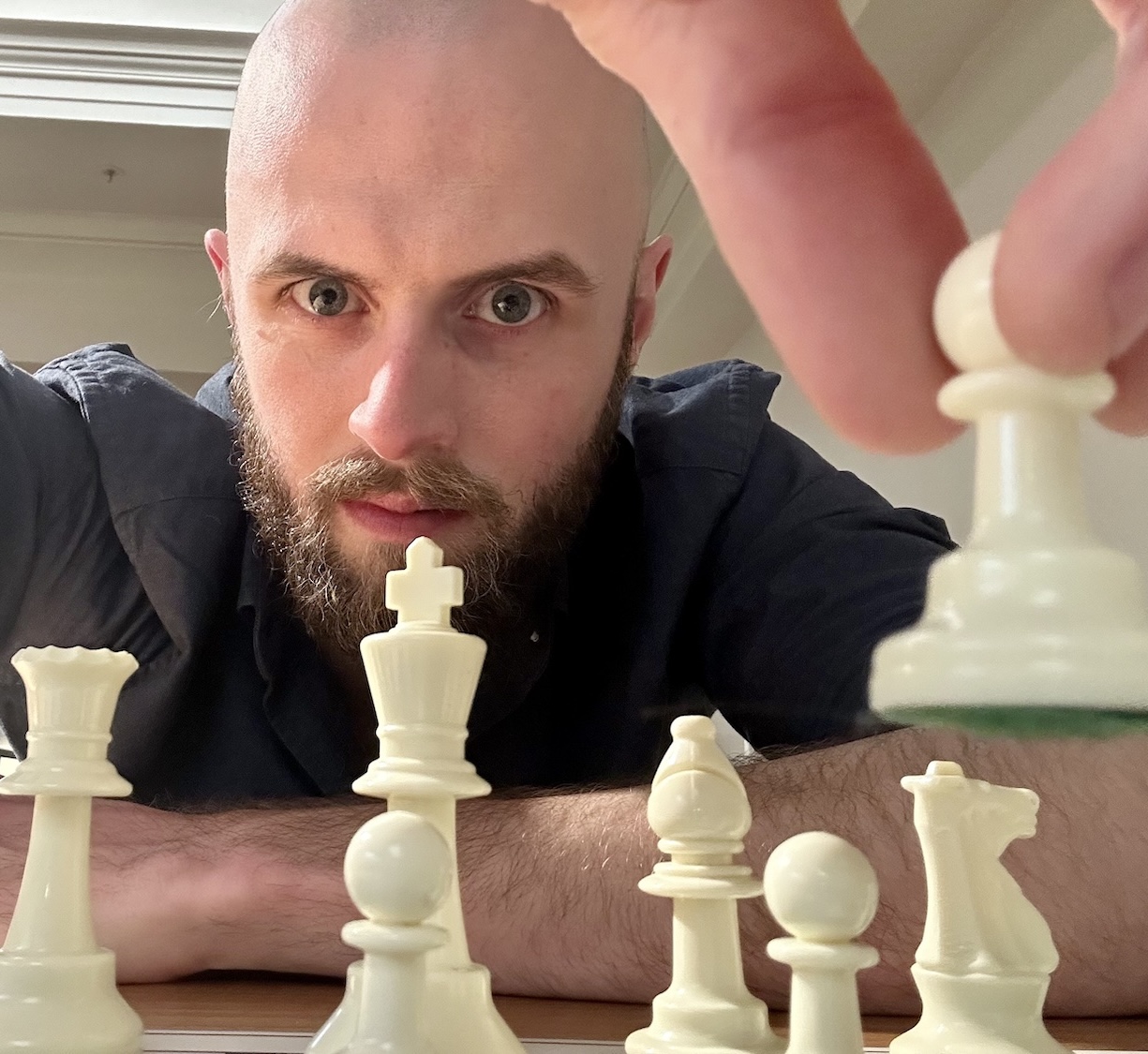
We think a lot more about the pawn on e4 than we do about the space it left behind on e2.
When we consider moving our knight to e5, we think about the outpost we could take, or the fork we could threaten. We barely notice what it means that f3 would be vacated.
It's certainly true in our calculations. There's only so much information our brains can hold at once. So, during deep calculations, our brain automatically starts to leave details out.
After 3 or 5 or 7 ply, working memory space is at a premium. Vacated squares are the first on the chopping block.
I call the effects of vacated squares "second order effects". And they're a weakness in the conceptualization skills of pretty much every Chess player I've worked with.
Beginner and intermediate players regularly miss the second order effects of their opponent's last moves. Or don't consider them for their own moves.
For advanced players, it may take a few ply in a calculation for things to slip. But eventually these second order effects will get fuzzy for them too.
Addressing second order effect issues has been a core of my conceptualization work with everyone up to about 2100 rating.
We are all pretty good at recognizing what the last move does. The active effects of the move. The queen now threatens mate. Or that pawn is attacking my knight.
Many of us see a move, quickly work out what it does, then jump straight to working out our own candidate moves. Or deciding the next step in the calculation.
We often give no thought to what the move no longer does.
As Kamil, a Don't Move member, described to me in an email recently:
When a piece makes a move then EXACTLY TWO things change in the actual position. That piece is on a square that it wasn't before and that piece isn't on the square that it was before. So if these are the two and only two things that changed, then it doesn't quite make sense to focus only on one of them. It's like deliberately ignoring 50% of inputs in order to make a decision.
It's like you wanna cross the street so you stop at the curb and only look to the left if any cars are coming, but don't look to the right.
He nailed it. Each move does exactly two things: it occupies a new square and it vacates an old one. We're pretty good with the former, but very bad at recognizing the latter.
This happens because we're human. With human brains.
Our brains are designed to respond to threat, active threat. They're far more interested in the fact the tiger is in front of us than that the tiger is no longer over there somewhere.
This doesn't just happen in our Chess. It's built into the human experience.
For example, we regularly say 'yes' to events without considering what that blocked out chunk of time will mean we don't get to do.
We say 'yes' while thinking only about the active effects. The fun we think we might have at the event, the friends we think we might see, or the exciting places we'd get to visit.
As it gets closer, we start noticing the second order effects. The family time we have to skip, or the project that has to be pushed out.
It's a theme throughout our lives, so it makes sense that our Chess is no different. Like in much of Chess, we're going toe-to-toe with human psychology here.
Second order effect issues can show up in a number of ways.
1. Ghost pieces.
The piece moves in our mind, but we can still see it on its old square on the board in front of us. Ghost pieces occur in part because we don't give any conscious attention to that square having been vacated. There's no part of our brain that reminds us "actually no, that square's empty".
2. Not noticing the opening or closing of lines.
We've all done it. The opponent moves a pawn. We respond to the pawn's active effects and consider whether we should take or push.
Then our opponent sends their bishop from the other side of the board, through the newly opened gap in the pawn structure, to capture our queen for free.
Many games have been won and lost over an unnoticed open line. Second order effects are a killer.
3. Missing resources and opportunities in calculations.
The deeper we go into a calculation, the more likely we are to miss second order effects. If we don't notice during our calculation what each move is no longer doing or which lines are opening up, we'll miss ideas that could win – or lose – us the game.
I'll be totally honest here. Second order effects are difficult to resolve.
Because it's not a conscious process that's causing them in the first place.
Our eyes see a move (or we calculate a move), and our intuition leaps straight into telling us the active things the move does.
To use Kamil's metaphor, it yells "there's no cars to the left", and we find ourselves deciding whether or not to cross the road based on only that information.
What we need to do is build a habit that is as automatic as our intuition.
Something that will help us get between our intuition and our decision making. Give us the opportunity to check for second order effects before we start thinking about what we should do.
The habit we want to build is this:
Every time you see a piece move or consider moving a piece, identify just one thing that's changed because the piece has vacated that square.
Just one. For some moves it'll be really simple. For others, a little tougher.
But find one.
You may find something critical. Or you may end up noticing 2 or 3 important second order effects from that move. It may kick off a whole new line of calculation or evaluation for you.
Or it could be something as obvious as "the knight vacating g1 means the rook can now move if it needs to".
But you won't know until you've checked.
This will be a really tough habit to build.
You'll start off well, then something will happen in the game and your intuition will take over. You'll find yourself having gone 5 or 6 moves without recognizing vacated squares at all!
This is perfectly normal, and to be expected. Remember, you're fighting human psychology here. We're not designed to notice vacated squares.
Here are some tips to help you build the habit as effectively as possible.
1. Start the habit from move 1.
Any habit of this sort needs to be done from the very first move of every game. I know you know that d4 means d2 is empty. I know you've seen it a thousand times.
BUT if you don't do it from move 1, you're likely to forget to start until you've already made a mistake!
2. Do it every time you see a piece move or consider moving a piece, in any context.
Do it in puzzles, in opening study, in practice games, in calculations. Whenever a piece moves, or you consider moving a piece, identify a second order effect.
Don't just leave it for your games. The more universal you make this habit, the deeper its impact will be. And the more likely your brain is to actually adopt it.
3. Forgive yourself when you screw up.
You will screw this up. Many times. It may never be fully integrated as a habit. And that's ok.
But every step toward it will help.
Every move in a Chess game does two things. It occupies a square and it vacates a square.
We'll play much better when we've trained our brains to notice both.
Here's to the journey,
Aiden