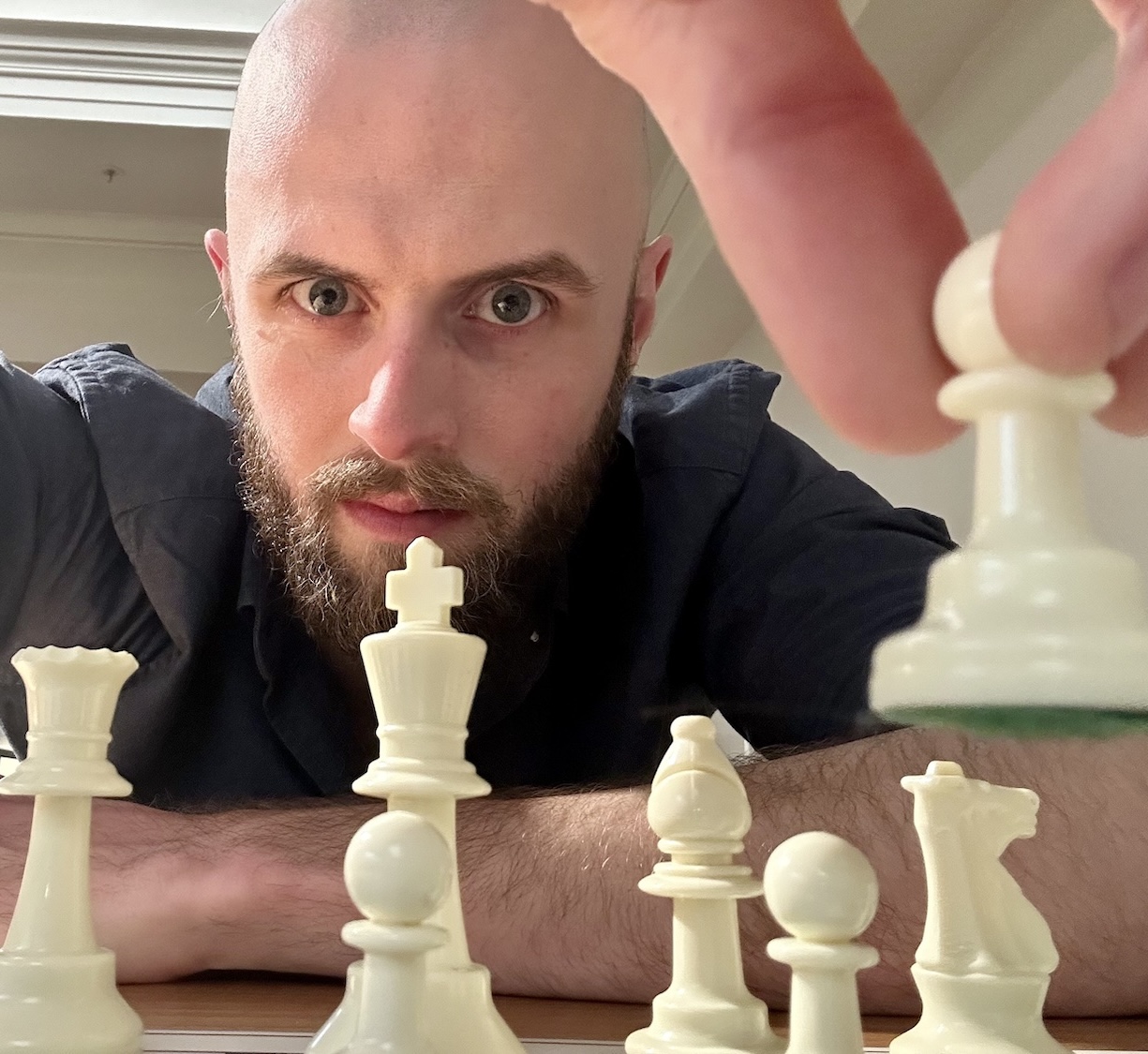
Sometimes, Chess paralyzes us.
We find ourselves staring at the position, unable to muster anything resembling a coherent thought.
Our mind is just blank.
Other times, "blank" is the wrong word. We do sense some kind of thinking going on in our heads. But it's the same thoughts we've already had, over and over.
We find ourselves calculating the same line again and again. No new information or insight comes to us.
It's like our brain is stuck in a loop, and we're unable to break out of it.
Freezing is one of the most common responses we feel when our seven slots of working memory come under too much pressure.
Here's what's happening when it occurs.
While we experience the process of thinking as one big all-at-once occurrence, it's actually broken up into a few different functions that each need their own little bit of space in our seven slots.
First, we have our baseline concept of the current position. This is the information that our brain has identified as important from the position we're in. Our eyes take in the piece locations and our brain filters the information down to something we can work with.
Second, we have a place to store the information created or transformed by our thinking. This could be whatever calculation or evaluation that we're doing, or the plans we're making.
This storage function isn't active. It doesn't do anything with the information it's holding. It simply holds it.
Third is our active thinking. This is the bit that manages our ideas, our creativity, our "Ooh, what if I did this?" tangents. It drives our calculations forward.
The baseline concept of the position, the storage area for our thoughts, and the space for active thinking. Three separate functions, and we need all of them to think properly in a Chess game.
Normally in our lives we have plenty of space in our seven slots to give each of these functions the space they need. But Chess hits our working memory resources extremely hard, and sometimes sacrifices are made.
When our seven slots overload, our loyal labrador will leap into action. And sometimes it will prioritize resources away from one or more of these three functions.
If it drops the active thinking function, then we find ourselves looping over and over the same variation we've already considered. Not learning anything new about it, just looping.
If it drops the active thinking AND the storage area functions, we go blank. We stare at the position but no thoughts come about what we could possibly do.
If it drops all three functions, we feel completely unable to take in any information.
Even the position we can see right in front of us isn't making any sense. It seems random and meaningless, like we're looking at some strange checkered alien artifact covered in odd totems.
(While not caused by the same thing, the feeling of a total Freeze is like what happens when we repeat the same word over and over. The word starts to lose meaning and eventually seems like random sounds. That phenomenon is called Semantic Satiation, and this video's worth a look for more on that.)
Freezing is different from Forgetting and Freewheeling in one key way: we generally know when we've Frozen.
Normally our labrador just works in the background and we only find out what it's done when we make the mistakes. But when we Freeze, we're often very aware of it.
It can be a distressing experience. Triggering frustration or anxiety, and leading to an emotional cascade.
We sometimes beat ourselves up for it, accuse ourselves of not trying hard enough to concentrate. But that's rarely the case at all.
Sometimes we attribute it to fatigue or distraction. That's closer to the truth because those things can cause us to have fewer slots to work with. They hog space and make our seven slots overload sooner.
But we can feel totally awake, alert, 100% concentrating, locked in to the game, and still Freeze. It's more about how your brain works than anything you are doing or not doing.
Since we often notice when we've frozen, there's a chance we can actually do something about it.
We won't always be able to pull ourselves out of a Freeze (because, surprise surprise, the self-control we need to do something about it also takes up slots), but sometimes we can.
The key to resolving a Freeze is to give your slots a chance to clear, then rebuild your sense of the position from scratch. This reduces your mental load, then sets you up to make the best decision you can.
Here's the 5-step technique I recommend for resetting a Freeze:
1. Stop thinking about the position and look away from the board, ideally at something visually interesting.
Finnish psychologist and researcher Pertti Saariluoma identified that visual tasks were more likely than verbal tasks to have a negative effect on blindfold Chess performance. In other words, dealing with visual stimuli can interfere with our mental representation of the board — which is exactly what we want right now!
2. Take 3-5 deep breaths while really paying attention to the visually interesting thing.
The breaths allow your brain a chance to lessen any emotional factors that could be contributing to the overload. Change the amount of breaths based on how much time you have on the clock. Obviously, more is better, but sometimes you don't have that luxury.
3. Stretch gently. Let your attention rest on the muscles being stretched.
The stretch gives you a little boost of energy, and directing attention to the body helps finish off that working memory reset.
4. Look back at the position and evaluate it with the KMAPS structure or whichever evaluation technique you prefer.
This is where we start rebuilding the position in your mind. You'll do that by completing a structured evaluation of the position, forcing your mind to notice each of these details.
The KMAPS evaluation structure is my favorite. Identify which color pieces are doing better in each of the following areas:
King safety, Material, Activity, Pawn structure, and Space.
This will make you take notice of the wider position, and build a more holistic sense of what's happening.
Resist instantly playing any moves that come to you during this process. They are just your intuition getting excited. You're vulnerable in this moment to Freewheeling, so be wary.
(More on Freewheeling in Part Four.)
5. Only then, once you've looked over the whole position and assessed it, think about moves.
By this point, you should be feeling clearer. And there should be some space now for thinking.
(This is also a useful exercise to reset after you've been distracted or felt a strong positive or negative emotion.)
With practice, you could get through those steps in 30-60 seconds. In some time controls, that's a lot of time. If you regularly play faster time controls, experiment with which parts of the process you find the most effective and go with those.
If you've got the time, do the whole thing. It's worth it to help avoid a mistake.
Freezing is a pain, but it's the easiest to deal with. Our other two Fs, Forgetting and Freewheeling, are much more sinister and difficult to resolve.
You'll find the article about Forgetting in Part Three. ...Unless I forget.
Here's to the journey,
Aiden