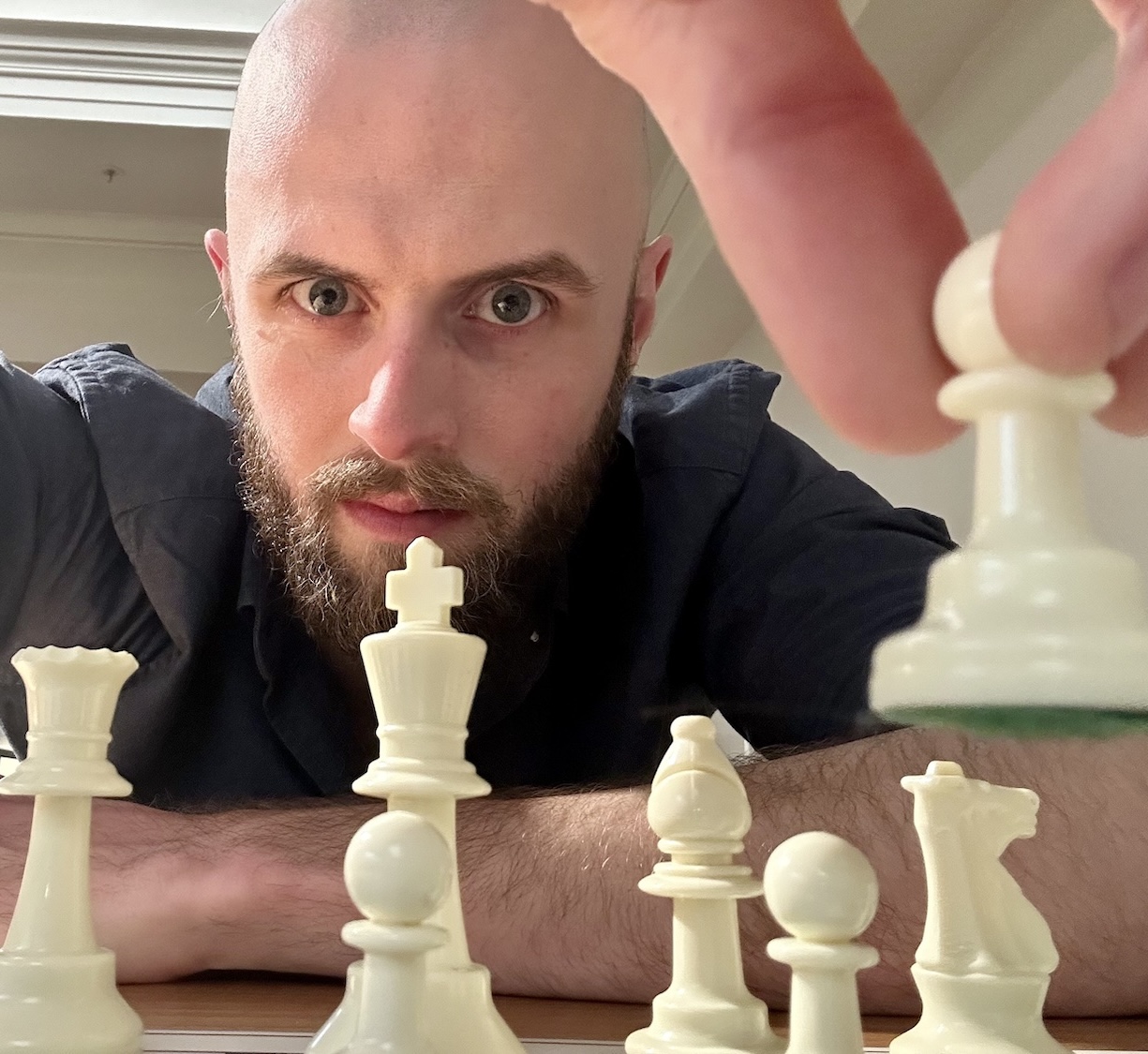
If I've heard it once, I've heard it a thousand times.
"I found the answer to the blindfold exercise, but I cheated."
When I hear that comment from a Don't Move member, or from a coaching student, I know what's happening.
It used to confuse me, but it doesn't anymore. I know what's coming.
They don't mean they peeked at a board. They didn't write the moves down to make remembering them easier. They didn't plug the position into an engine.
No, the way they "cheated" is simpler than any of that. And, as far as I'm concerned, much sadder.
I know what the comment means, every time. But I'll often ask anyway, "what do you mean by cheated?"
The specifics of the answer change from person to person. But it always starts with the same five words:
"I didn't really see it."
It's like a punch to the gut for me.
"I didn't really see it, I just remembered the sequence of moves as it played out."
"I didn't really see it, I just logically worked out the escape squares and blocked them."
"I didn't really see it, I just repeated the main threats of the position in my head until I found the answer."
— It's always something like that. Every time.
They nailed a challenging blindfold exercise - a great feat for any Chess player - but feel they don't deserve any congratulations. Just because they didn't see pictures in their head while they did it.
I've had people win 35-move games against my blindfold trainer just to tell me they "cheated" because they didn't have a picture in their head while they did it.
I'm tired of it. Absolutely tired of it.
I'm tired of hearing it and seeing it, but mostly I'm tired of adult improvers being made to feel it.
There's something I need to directly address here, and it's about time I did.
The Chess world's obsession with mental pictures is toxic for adult improvers. It needs to change.
One adult player does something amazing, solves a Chess puzzle without looking at a board, and robs themselves of any feeling of pride because they didn't see it "properly".
A second calculates with total accuracy a complex line, but doubts themselves because they don't have a clear picture. They assume they've missed something, simply because they can't see it "properly".
Another doubts they'll ever improve. They have aphantasia and can't create mental pictures at all. Without mental pictures, they'll never visualize "properly".
I'm over "properly".
For us adult improvers, "properly" does not exist.
As an adult, you have spent decades on this planet. And your brain has spent those decades building ways it likes to do things.
And they're weird, wonderful, wild ways. Totally unique to you. Because no one else has the exact combination of genes and experiences that you have.
I've seen as many different mental models for Chessboards in my work as different people I have worked with.
It does not matter what form your mental board takes. If you understand what's happening on it, you're doing it right.
But this idea of visualization and mental pictures has such a grasp on us.
As far as I can see, there are two main reasons we're in this mess.
The first is that mental representations in Chess are horribly understudied.
The last serious attempt occurred in 1894!
It was a breakthrough study for its time. Alfred Binet, who later invented the IQ test, surveyed dozens of Masters to work out what went on in their heads. A lot of the data he collected is still relevant today, but his conclusions were naïve.
He assumed, because many of the stronger players he surveyed claimed to use mental pictures, that visual had to be best.
To support that conclusion, he had to misinterpret and discount quite a few of his survey responses. He even went so far as to declare some players who claimed not to see mental pictures, like top French player Samuel Rosenthal, were lying.
And, in the absence of further studies, those conclusions have stuck with us.
The second reason is that most people teaching and talking about Chess started playing as a child.
Psychologist Graham J Hitch and his team at the University of Manchester discovered that almost all kids start life as visual thinkers, and this propensity toward visual thinking can change as we age through the single digits and into adolescence.
Linda Silverman's work shows us that we end up, by the time our brains are fully developed, spread across a spectrum of visual and verbal thought like below.
We all start strongly visual as children, and 65-70% of us will drift to varying degrees toward verbal thought as we age.
The majority of current Masters began Chess at an age where they were extremely likely to be visual thinkers.
If you maintain your engagement with Chess from childhood - as practically all Masters did - you're likely to maintain that visual connection with the game. Even if the rest of your brain shifts verbal.
An example of this is FIDE Master, Twitch streamer, and all-round good guy, Lefong Hua.
When he's playing blindfold Chess, he has a fully realized, photographic, 64-squares in front of his inner eye. But in his regular life, he thinks mostly in words with the occasional image here and there.
His Chess is visual, but his life is verbal.
If he had started Chess this side of puberty, he would likely have a verbal model instead.
While I'm angry at the pain the idea of "proper" visualization causes adult improvers, I know there's no one in particular to blame.
Alfred Binet did extremely well for the 1890s, especially considering how little he knew about Chess in general.
And, zooming ahead to the modern day, it's not the Masters' fault that most of them are visual thinkers.
There's not some old guard of visualization traditionalists purposely spreading out-of-date information. No, it's trickier to overcome than that.
All these assumptions about visualization are just part of the Chess culture. They're baked in.
Heck, most of us had a clear idea about what "proper" Chess visualization looked like before we even got into Chess.
It's one of the most common things I hear when non-Chess players learn I run a Chess visualization business. They say, "So you see the whole board when you close your eyes?"
No, no I can't. Neither could Alekhine. Neither could George Koltanowski. Neither could countless other players from throughout history and today.
Neither can 60-70% of you, and that's ok!
The only way we can shift the culture is if more adults learn about how their own brains work, and they spread the word to others.
I want to replace this idea of "proper" visualization with one clear message:
It's not the pictures that matter, it's the understanding. If you understand what's happening, you're doing it right.
I ask that you please help spread that message.
And I ask that, however your Chess brain works, you be proud of it.
Be proud that you use logic to solve blindfold puzzles. Be proud that you tell yourself stories, or use math, or only see sections of the board at a time.
Be proud of what your brain does, because it can be every bit as good as that mythical "proper" visualization ideal.
If your brain does do things that resemble that ideal, be proud of that too.
Whatever your brain does, know that it's worked really hard on it. Since the day you were born. It uses it to help you navigate your entire life.
And if it's good enough to manage your life, it's sure as eggs is eggs good enough to handle a Chessboard.
Support your brain, train it, make it stronger. But every step of the way, trust it.
It knows what it wants to do.
I promise you, it's not cheating.