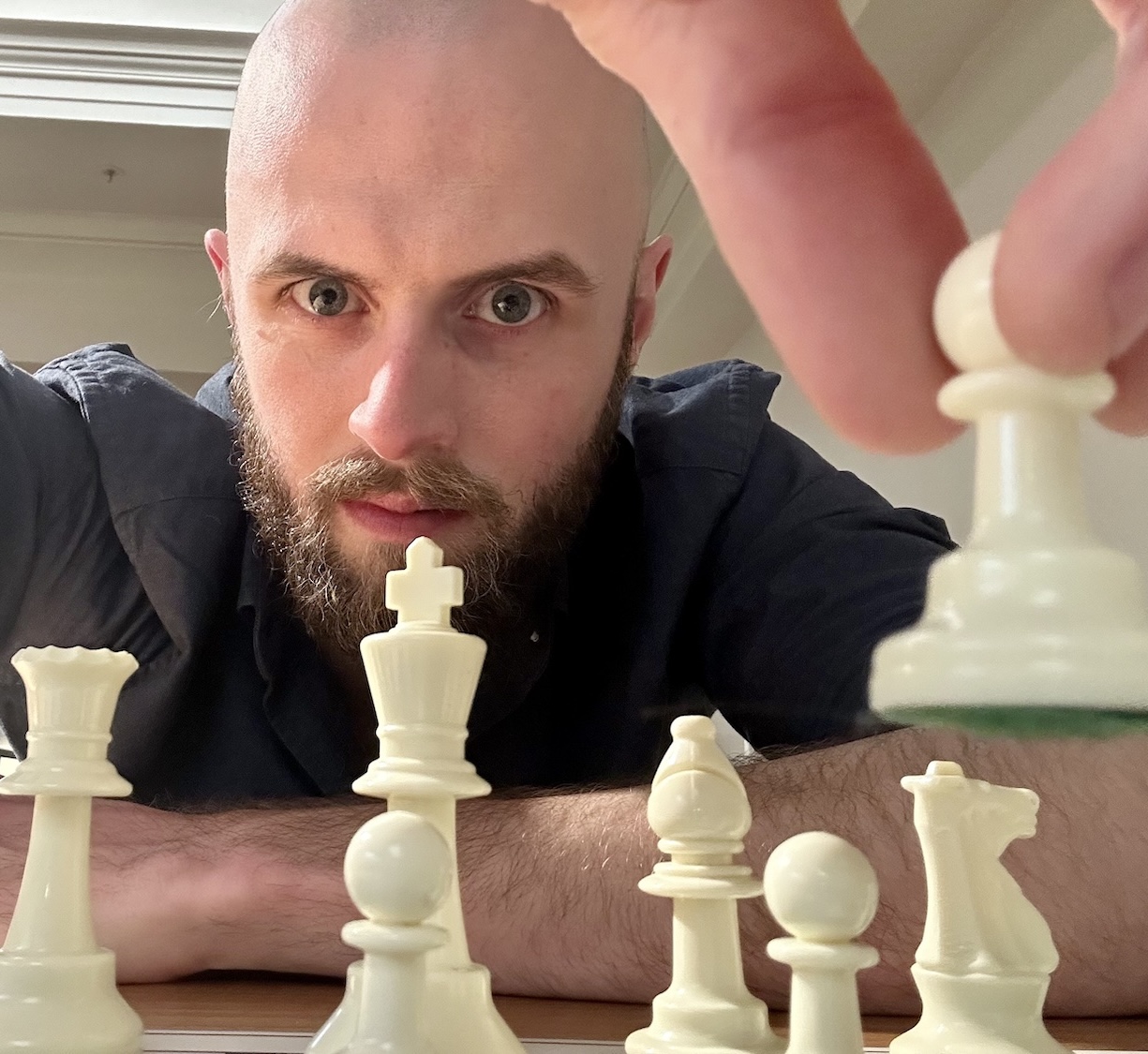
Trusting our natural conceptualization model feels like a leap of faith.
There's something comforting and concrete about the traditional idea of visualization. We envy Beth Harmon in the Queen's Gambit, with the pieces shifting around, fully realized, on the ceiling.
We figure we'd play better if we could just see the board in our minds in exactly the same way we see the board in front of us.
Anything less than a detailed image feels too abstract. And abstraction, for something as complicated as Chess, makes us uneasy.
Maybe your brain prefers seeing sections of the board at a time, like a roving spotlight. How can you be confident you haven't forgotten something about the parts of the board not in the spotlight?
Maybe your brain tells stories with words to keep track of what's happening. How can you be sure your story doesn't have any glaring omissions or mistakes?
Maybe you can feel the pieces floating in space, but not see the board itself. How can you be certain how the pieces relate to each other if you don't see the squares beneath them?
I definitely understand the drive to conjure pictures in our minds. The other option, learning to trust that our brain can navigate abstraction — nay, can thrive in that abstraction — feels scarier.
If we can't see it like a photo before our eyes, how can we be sure we're not missing anything?
The other week, I received an email from a reader that stuck with me. Amongst other things, they said:
"I'm learning to trust the process. I've stopped trying to create an image and instead let my brain do its own thing. The exercises are getting easier and I feel clearer. I don't know how my brain is doing it, but it's working."
It's the last part that grabbed my attention. This reader felt clearer when they stopped trying to force the image, but they couldn't describe exactly how or why. They just know it's working, and have to trust it.
To trust it requires letting go. Accepting that we don't understand how. Taking a leap of faith.
It's a challenging hurdle. I've received many emails over the years from members and students that got fantastic results when they stopped trying to force mental pictures, but who slipped back into old habits after a while.
And it's always for the same reason: the idea of mental pictures feels more concrete.
They get better results when they trust their brain. But it's too uncomfortable to let go, lean into abstraction like that. So they accept less clarity in exchange for feeling like they're doing something more "concrete".
This is one area where the players with aphantasia have a massive advantage. They physically can't create mental pictures, so they have no other option than to work out what their brain wants to do.
It's those of us who kinda-sorta-sometimes can force a blurry mental picture who get caught in this trap.
If this is all ringing true for you, I hope this article helps you let go a little.
I first want to challenge the idea that a mental picture is more reliable and concrete. To that, I have two responses.
First, if we're being honest, totally truly honest, we'd have to admit that our eyes miss plenty of details about positions when we can see them right in front of us. Often extremely obvious stuff. Like what-the-heck-just-happened facepalm level obvious stuff.
(I don't mean you, of course. I mean the other people reading this. You'd never miss something obvious...)
Our eyes are not exactly infallible. Why do we feel so sure we wouldn't miss the same stuff if we could see the board in our heads too?
My second response is that an abstract conceptualization model can't be a weakness, because most great Chess players from history had abstract models.
Very, very few saw the whole board in their mind at once. GM Andrew Soltis once wrote, "nobody sees 64 squares and 32 pieces at the one time." He's incorrect that nobody conceptualizes that way, but he can be forgiven for thinking that — because it is very rare.
I've only met two players that have a photographic mental board in my four years running Don't Move. (And, spoiler alert, they aren't inherently better or worse at the game than anyone else.)
The only GM I know for sure saw the whole board at once was Fritz Sämisch.
And for every Sämisch, there are many more Alexander Alekhines (who used mostly verbal stories), Eric Rosens (who has a roving visual spotlight), and Andrew Soltises (who clearly doesn't see the whole board).
If anything less than a photo-quality mental picture is somehow a barrier to clarity, then the vast majority of great players had the same barrier.
The only way forward is to let go of what you think your brain should do. Or what you would like it to do. Or what you wish it did. Just let go.
Instead, find what it wants to do. Accept that it might not feel as concrete as you imagine a mental picture might.
As you're starting out with conceptualization training, you may have the experience my reader had. You may feel that things are clearer, but you don't really know why.
It feels less comfortable, but it's working.
Focus on the "it's working" bit. Let the "less comfortable" bit fade with time. Because it will eventually.
Keep training your conceptualization with the Chess Visualization with Aiden Rayner podcast (Apple | Spotify), or in the full membership system.
Observe your brain during these exercises the same way you'd observe an animal in the wild. Watch it solve its problems in whichever way comes naturally to it.
Resist the urge to change things up. Resist the urge to copy what someone else's brain does, or to experiment with the different models you've heard about in my work.
There's no model you can force that will work near as well as the one your brain chooses for itself.
You may not understand it. It may not feel "concrete". But it will work if you let go, if you choose to trust your own brain.
It's been a stalwart servant your whole life. It deserves that much.
Here's to the journey,
Aiden