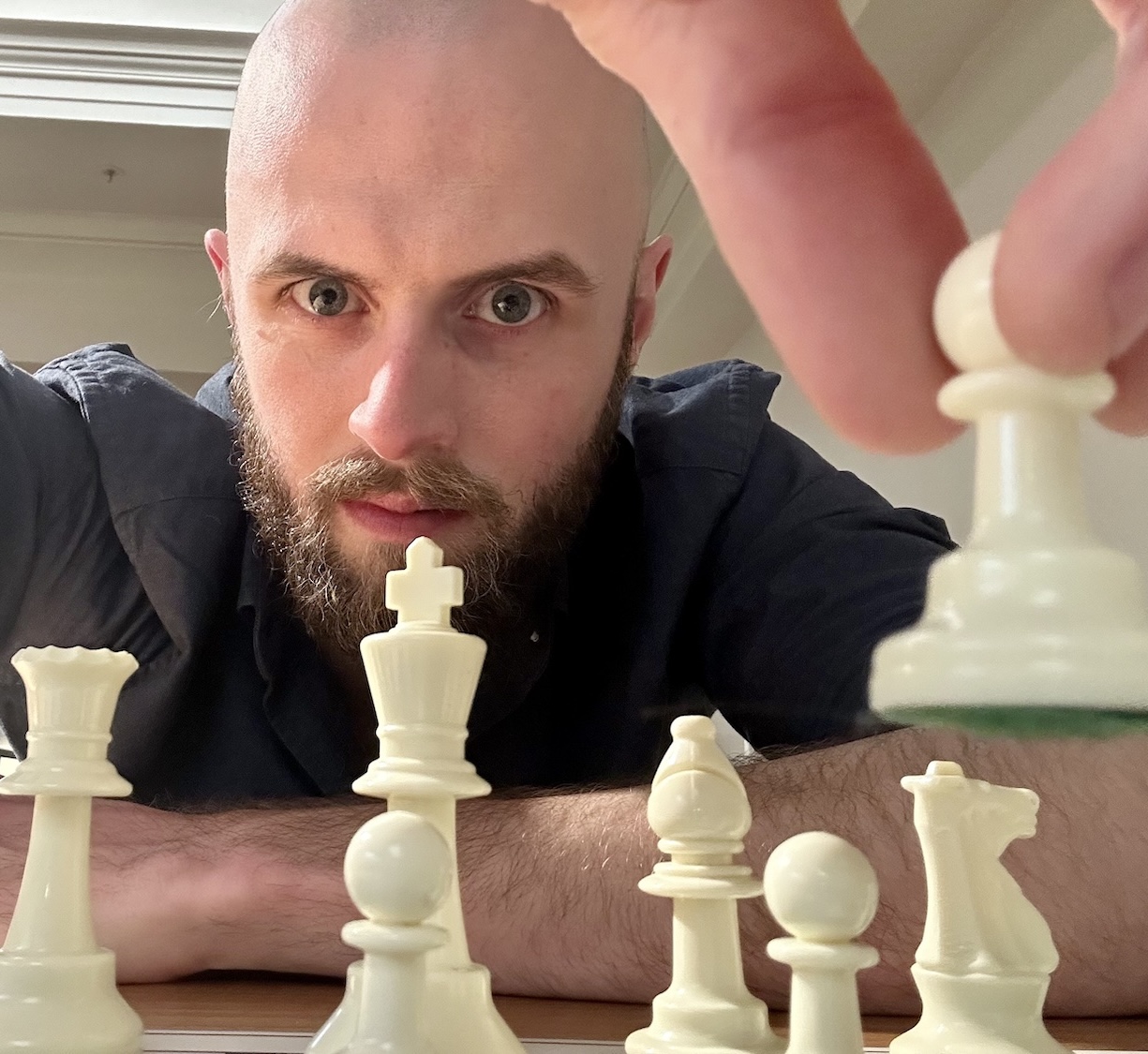
The player with the losing position has a big advantage.
Stockfish doesn't recognize it, and you can't really quantify it, but we've all felt it.
It feels easier, for some reason, to get the come-from-behind swindle than it does to win from a winning position.
There's loads of Chess content about how hard it is to actually win when we're winning. Much of it focuses on the strategy of handling these positions.
We all know that we should simplify. Trade down. Play simple moves. Get a passed pawn. Don't go for brilliancies. The strategy is clear.
The challenge is in executing that strategy. We start making silly mistakes, as if we magically lose 200 rating points of skill as soon as we get ahead.
Well, that happens to all of us. From a brain perspective, we actually are less good when we're winning.
From the start of the game, our brains are uncomfortable. They know the game could go either way, and that tension holds them in a state of high alert.
Researchers call this a state of "cognitive strain". In this state, you are more vigilant, watchful. You become less intuitive, less confident in your decisions, more likely to double check things and spot the errors in your ideas.
That's a pretty good state for a Chess player. The cognitive strain keeps our deeper thinking processes in charge and helps us to avoid a lot of "silly" mistakes.
(You can have too much cognitive strain, and we often do have too much cognitive strain in Chess. That's when we overload. But I'm not going to go too deep into that here.)
Maintaining that state is taxing on our mental energy, and our brains don't like to do it for too long. They're designed to handle short, intense bursts of cognitive strain, but nothing too drawn out.
They're always looking for an excuse to stop working so hard.
The moment we realize we're winning is the most dangerous moment of a Chess game. Our brains take it as the cue to relax. It's like a switch gets flipped in our heads.
Our brain breathes a big sigh of relief. It finally feels comfortable, the earlier tension of the game washes away. It enters a state of "cognitive ease".
(Alternately, if we've had dozens of painful experiences losing "won" positions we can sometimes become anxious wrecks when we're winning. That burst of emotion causes its own problems.)
When our brains are feeling cognitive ease, they stop working near as hard. They don't pay as much attention to what each move does. They don't put as much care into their decisions.
We become intuitive, prone to freewheeling and playing moves on autopilot.
In that state, it's difficult to follow any kind of coherent strategy. Our brains have switched off the focus and deeper reasoning that got us to the winning position in the first place.
We become pretty likely to throw the game away.
The player that's losing has a different, easier problem to solve. They simply need to avoid tilting.
Tilting is a state with way too much cognitive strain. Our emotions add a bunch of pressure, we overload, and our brain checks out.
If they can avoid tilting, they maintain the Goldilocks state of just enough cognitive strain. They never get comfortable. They're always thinking hard. Their brain stays on high alert.
Emotionally, they already accept they're probably going to lose, but they don't want to make it easy. With that mindset, what I call detached interest, many of us find a Chess strength emerge from within that we didn't know we had.
Our brains work harder when we're losing, and switch off when we're winning. On the board, the winner has the advantage. Cognitively, it's the loser with the edge.
The first step to resolving this is to be aware that it happens. You've already ticked that off, congratulations.
Then we need to watch for these moments in our games. We can't stop our brains from flicking the switch to cognitive ease, but we can catch ourselves when it occurs. Then we can take actions to get back to our best.
I recommend you build a short "I'm Winning!" routine. Something to do when you first notice you're ahead in a Chess game.
The purpose of the routine is to add discomfort and switch your brain back on. Below are 3 suggestions for pieces you might include in your own routine. Try them out, and add or remove anything that makes sense to you.
1. Sit in an uncomfortable way
Our brains can enter states of cognitive strain in all sorts of ways. Physical discomfort is one. If our bodies are physically uncomfortable, our brains see that as a potential threat and stay more alert as a result.
2. Identify 2-3 dormant ideas in the position that your opponent could use to swindle the game from you.
Even in completely dominant positions, there's always some risk of losing. Look around the board for 2-3 ideas, no matter how crazy they seem, that your opponent could theoretically use to beat you.
Maybe your king and queen are on forkable squares. Their knight's nowhere near it, but the idea does exist in the position.
Spending a little time noticing these things can help disrupt the sense of safety that your brain has slipped into.
3. Go splash water on your face and psyche yourself up to finish the game well.
This one is inspired by Don't Move team member WFM Tihana Ivekovic, who last week secured her final norm for the WIM title!
The first time she noticed that she had a winning position in each game of this tournament, she took a short break. She went to the bathroom, splashed water on her face, looked in the mirror and repeated to herself, "I will not freewheel. I will not freewheel."
When she felt focused and ready to finish the game off well, she returned to the board.
In one or two of the games, she didn't have time on the clock to go for a walk. So she just closed her eyes in her seat and did the same in her head. "I will not freewheel. I will not freewheel."
She set an intention to finish the game well, put her mind on high alert against overly intuitive thinking, and got back to the Goldilocks state of cognitive strain. She crushed it!
(Congratulations, T. You've worked so hard for this. The Don't Move community is proud of you!)
When you notice you're winning, stay vigilant. While you might know that the game's not truly over yet, your brain doesn't. It's already planning the celebration dinner.
Learn to watch for those moments. Recognize when they happen, and immediately take steps to switch your brain back on.
Intentionally add discomfort and tension. Give your brain a reason that it shouldn't relax yet.
Then calmly, clinically, claim the win you deserve.
Here's to the journey,
Aiden