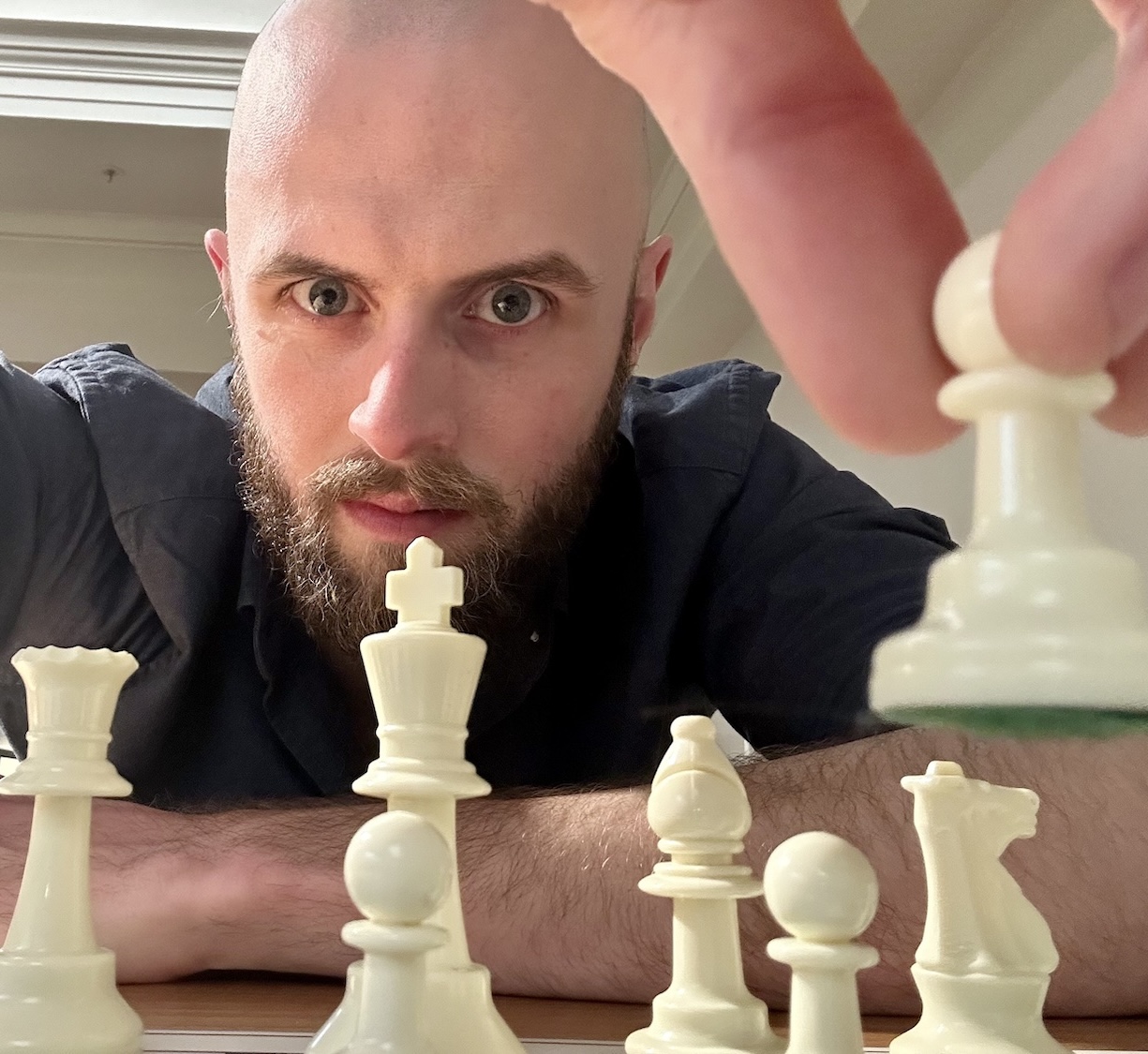
Calculation pushes our mental resources like no other part of the game does.
I often say that Chess is a game of knowledge and muscle. For calculation, this is particularly accurate. We need the knowledge to structure our thinking, see patterns, and strategize. And we need the mental muscle to hold the positions in our mind, juggle the variations, notice opportunities, and keep full clarity every step of the way.
In this article, I want to give you a path of sorts toward building the muscle part of calculation. Over my time working with members and coaching clients across the rating spectrum, I've noticed a progression of sorts that most of them have followed.
Following this guide will not automatically make you a calculation god. But it will point you in the right direction for building the relevant mental muscles.
There are a lot of ways to go about this stuff, and this is simply one way. Use this as a starting place. Tweak it to your brain and your needs.
We're all different. When it comes to adult learning, one-size-fits-all is a myth. So take charge!
Phase One: Learn How Your Brain Works
This is the most important stage. As adults, our brains have spent decades developing ways they like to do things. Your brain has had to deal with all sorts of complex information since the day you were born, and it has built a toolkit that it uses to do that.
The more we can lean into and improve upon this natural toolkit, the easier it will be for your brain to handle the crazy mental demands Chess calculation places on us.
The simplest way to support your brain to do this is to put it under pressure, like in blindfold exercises, and let it respond how it wants. When you're doing any calculation and conceptualization training, focus on the outcome and not the process.
In other words, put your effort into understanding the positions — aim for total comfort and clarity in your mind — but let your brain do its thing. Watch what it does as if you were an outside observer. Be curious.
Take notes. Write down what you discover about yourself and your mind. Reflect on the process.
For a more in-depth approach to this phase, the 5-part Finding Your Model series is the place to start.
Phase Two: Know the Current Position
Calculation requires us to do to future positions all the same things we have to do to a position that's right in front of us. If we can't recognize opportunities, threats, ideas, and evaluations in the position in front of us, we're not going to have much luck doing it in future positions either.
The more comfortable you are in noticing and holding the ideas in the current position, the better chance you'll have to notice the same things when you're calculating.
To start building this skill, pull up any Chess position and ask the following questions:
- Whose position is better and why? (To ensure you're considering the whole position.)
- Where are either player's biggest strengths and weaknesses? (To help you notice the most important details.)
- What are the key squares and points of tension in the position? (To help you identify the key dynamics of the position.)
- If either player could secretly pick up any piece and put it anywhere else on the board, where would they put it? (This helps you notice strategic opportunities.)
- If either player had two moves in a row, what would they play? (To help you find key tactical ideas.)
You can also investigate Position and Lost Piece exercises in the Chess Visualization with Aiden Rayner podcast (Apple | Spotify). And members can take a deeper dive with Awareness and Memory exercises.
Each of those exercises will help train you to create clarity and detail within a single position.
Phase Three: Master the Ways One Move Changes Things
A lot can change with one move. Some things get stronger, others weaker. Lines open and close. Opportunities appear and dissolve. So much can change at once that we often miss some of the more subtle details. With each move, at the core of it, we need to answer two questions: What is now true about the position? and What is no longer true about the position?
To answer those questions, we need to pass our attention over the whole position and recognize the things, big and small, that have changed. The first- and second-order effects.
To practice this, work through an opening line or game. After every move (I mean every move) write 5 sentences about the move and how it changes the position.
It's a LOT to write about one move, I know. You can't settle for a superficial description if you have 5 sentences to fill. By the end, you'll be scraping the absolute bottom of the barrel, noticing tiny details that don't seem to matter. And that's the entire point. Pretty often by the end of sentence 5 you'll have uncovered some detail about the move that you'd never noticed or considered before.
Supplement this work with Hybrid exercises from the Chess Visualization with Aiden Rayner podcast (Apple | Spotify), or Couple-Too-Early and Find the Blunder exercises for Don't Move members.
Phase Four: Stretch Ahead
Once you've built the skill of noticing how individual moves change positions, it's time to push the distance you can see ahead.
Early in my journey, I had the honor of speaking with the legendary Bruce Pandolfini. He told me that his aim with many of his students was to get them seeing 3.5 moves ahead with total clarity. He said, in most situations, that 3.5 moves is enough to reach master level.
That should be our aim. But this does not mean we should only train ourselves to see 3.5 moves ahead. We need to go further.
In your training, your brain can point all its resources at the calculation. In a tournament situation, with emotions running, fatigue, distraction, your brain doesn't have that luxury.
To reliably see 3.5 moves ahead in tournaments with crystal clarity, we need to learn to be comfortable with at least double that in our training.
To build this skill, you can attempt to read Chess books without a board next to you. Or try your hand at the Don't Move Blindfold Trainer (which is free to use forever).
You can also complete Opening exercises from the Chess Visualization with Aiden Rayner podcast (Apple | Spotify), or members can access Game exercises in the full system (my personal favorite way to train this).
In either case, pay deep attention to each move as you go. Every move you hurry through or think "I know this one" will make the moves to come much harder to track.
Take the time to do it properly; I promise you will get faster with practice.
Phase Five: Zoom Out
As we push ahead into a position, it's natural for us to zoom in tighter and tighter on the section of the board most relevant to our calculation.
This, as with everything of this nature, is due to the limits of our working memory. To conserve space, our brains prioritize the stuff that's all clumped around our target. If we're focused on the kingside, our brains prioritize the kingside.
This means however that we can miss what's happening in the bigger picture of the position. We become less and less likely to notice threats or opportunities on the other side of the board, and far more likely to miss all but the most obvious resources either side has on hand.
We need to build the ability to zoom out at the end of a calculation, and check that the resulting position is actually good for us. That's impossible to do accurately if your beam of focus is too tight on any one section of the board.
This is a tough skill to build. I've worked with many students who started with excellent, deep tactical calculation skills but who struggle to zoom out and evaluate positions even a couple moves ahead. This includes some Masters!
Work through the same types of training as in Phase Four, but take the time every few moves to attempt a position evaluation. It will be difficult, because future evaluations require huge amounts of information to pass through working memory, but stick with it.
If you're a Don't Move Member, you'll soon see a new Evaluation exercise style that Tihana and I are working on to better isolate exactly this element. In the meantime, focus on Opening, Game, and Find the Blunder exercises and make those attempts at evaluation as you go.
Work through the five phases, tweak them as you need. Be consistent in your training, but allow yourself to be patient with results.
Calculation places ludicrous demands on your brain, so be gentle. Celebrate the wins, find the joy in the failures.
Keep in mind always that your struggles are not some moral failing on your part, they're just because you're human. Human brains were not designed for Chess. But we play it anyway. And that's awesome.
Thank you for your time and attention throughout the Seeing the Future series. It, as always, is an honor to be able to guide you through all of this.
If you have any questions about topics we discussed, reach out any time.
May your calculations be accurate, your working memory plentiful, your second-order effects be noticed, and your future very bright indeed.
Here's to the journey,
Aiden