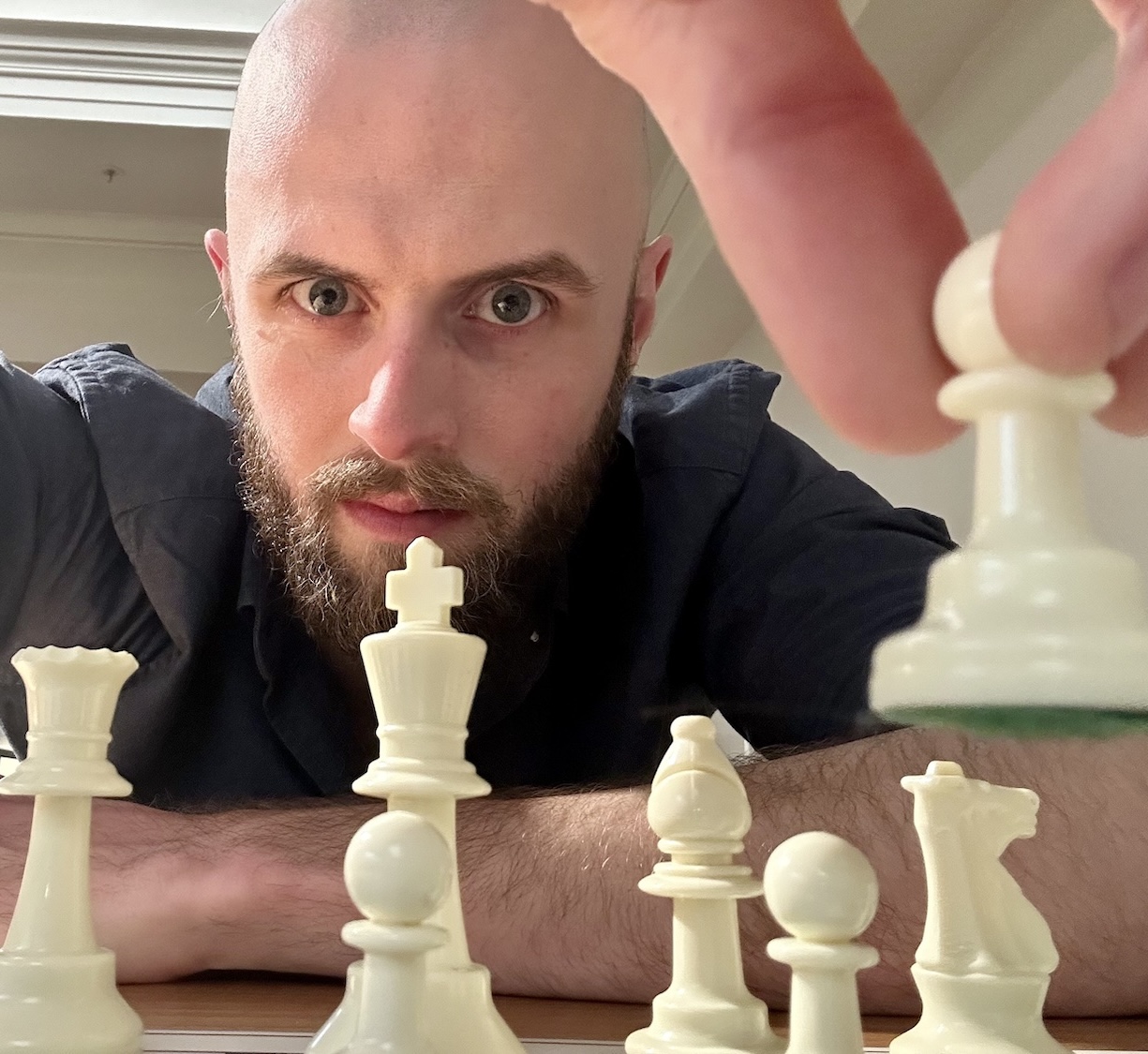
Calculation, in one form or another, is the thing we spend most of our time doing in a Chess game.
We think of a potential move and need to decide if that move is good for us or bad for us. Even before we consider what our opponent could do, we're calculating. We're thrusting our mind into the future and checking whether it's a future we like.
It's no wonder Chess calculation has been compared to life so often. Every move we make requires a little forethought: what does this next step mean for any steps that are to come afterward?
Unlike life, in Chess we see all the pieces in front of us. There's no hidden information. At least that's technically true. But we don't experience it that way.
We may see everything in front of us, but we can't grasp all of its meaning.
It feels to us like the board is coated in a thick fog. One that opens up only as we move into it. A fog that hides many rude surprises.
We seek a clarity. To pierce through the fog, and "see" future positions as well as we can see the one in front of us.
Chess calculation demands a lot of our mental muscles. And much of our success or failure depends on how well we can navigate those demands.
Fred Waitzkin in Searching for Bobby Fischer describes the mental demands of World Championship-level calculations as "roughly equivalent to doing the New York Times Sunday crossword puzzle in your head."
Our brains aren't designed to handle such large amounts of information at once. Just like we aren't designed to run 100m in under 10 seconds. Or climb Mt Everest. Or any number of other insane feats our insane species has achieved.
"Not designed to do that" hasn't ever stopped our species before. I see no reason it should stop us now.
We need to understand this struggle against our biology if we're to make progress on these goals. To improve your calculation, you need to know what these limits are and how to push through them.
Calculation is one of the most discussed parts of Chess improvement. But there are some gaps in that discussion. This Seeing the Future series is my attempt to fill the gaps.
It's a complicated topic, and there are a few key concepts I need to introduce before we can get into it.
First is our working memory, the seven slots our brains have for holding information related to whatever task we're trying to complete in the moment. Chess calculation puts huge demands on our seven slots, and they can quickly overload. When they do, things go wrong. (Read my dedicated series on working memory here.)
Next is intuition, the automatic, always-on part of our brain that subconsciously recognizes patterns, assesses situations, and responds to threats. Sometimes it's an ally, and sometimes a hindrance. How we understand and wield intuition has a huge impact on how accurately we calculate. (You can find my series on intuition here.)
Third is our attention, what we're noticing and what we aren't. Attention is the mobilizer of most other mental processes. Where we choose to point it has a direct impact on what we recognize, retain, and recall in our calculations.
Fourth is our conceptualization model, the mental representation our brains create to help us remember and navigate the current and future positions in our calculation. It could be visual (like the traditional idea of "visualization"). It could be verbal. It could be spatial. It could be some combination of each of them. Whatever form it takes, it will be unique to you and your brain. (Here's my series on models if you want to go deeper.)
Lastly is our thought process, the conscious, slow, methodical steps we go through. The structure of our calculations, our habits, the mental tools we use to help us make the right decisions. The right process can help keep us focused on the right things and act as a safety net against mental hiccups.
It's in the interplay of these concepts that our greatest calculation successes and failures lie. And it's the interplay that will be the focus of this series.
Improving our calculation is a journey, one we'll never finish. There are too many factors for us to ever be done. As I once saw in the chat of IM John Bartholomew's Twitch stream, "We all suck at Chess, including Magnus; just to varying degrees."
It's calculation that makes this true. Humans are fallible, and that's part of our beauty. Chess calculation shows up our faults. As we resolve any one of those faults, we will inevitably reveal several more.
If you regularly hang your queen, you probably haven't had much chance to notice or address your issues with endgame calculation. Once you stop hanging your queen, those issues will appear more often. As will your positional blindness. Or your issues with evaluation.
Behind mountains are more mountains.
Improvement in calculation is not the removal of errors. It's learning to make better errors.
It's my goal in this series to help you understand what's happening in your brain as you peer into the future. To help you navigate and resolve the various ways our adult brains interfere with the crystal clear thinking required for effective calculation. To give you practical insights, and a path to improving this critical Chess skill that's more in line with what your unique brain needs.
In short, to help you to make better errors.
And I won't do it alone.
I often say that Chess is a game of knowledge and muscle. We need the knowledge to know what to do, and we need the mental muscles so our brains can actually do it.
My focus, expertise, and research are firmly on the muscle side, on how your brain and the game of Chess interact. But a proper investigation of calculation requires some of the knowledge side as well.
For when that's required, I've called in some very special guests.
I've looked several parts ahead, and I calculate you will love this series.
Here's to the journey,
Aiden