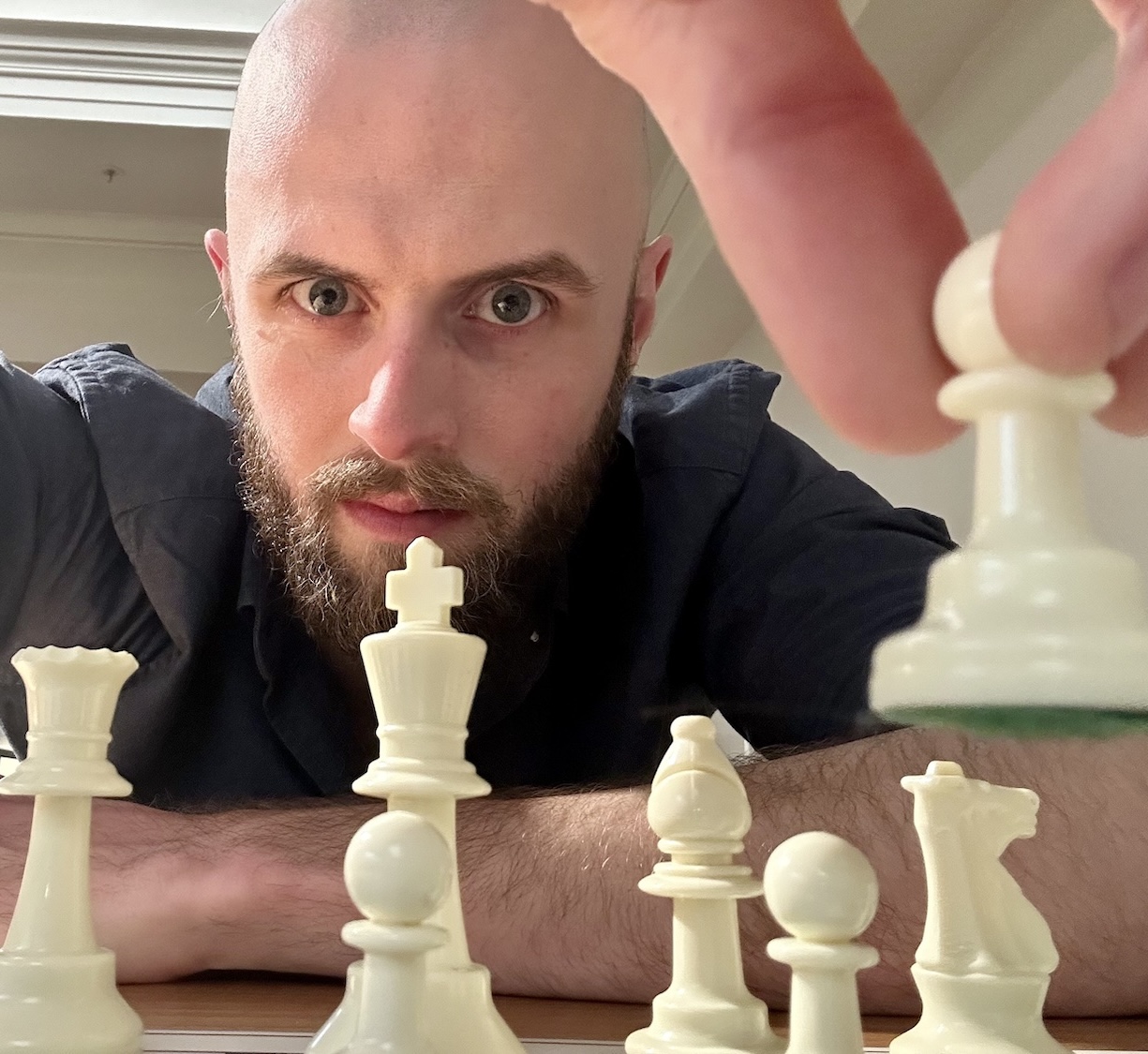
If you'd asked an 8-year-old Aiden what he wanted to be when he grew up, he would have responded, "Captain of the Enterprise!"
Even at that young age, I knew Star Trek was special. It showed a future where humanity gets over its issues and bands together in pursuit of exploration, knowledge, and growth. That inspires me to this day.
When it all gets a bit much, and my faith in humanity is tested, I return to Star Trek. It reminds me what I believe, that we will continue to grow as a species. That we've made progress, and we will continue to better ourselves. That it's a journey and, overall, we're headed in the right direction.
While still great stories in their own right, the future visions of Black Mirror, or The Matrix, or Dune, are not so positive. They subscribe to the idea we're headed for a fall; humans are humans, we won't evolve, we're doomed to repeat our mistakes again and again, ad infinitum.
I prefer the other vision. Bright, beautiful, positive, and empowering.
I'm a big sci-fi fan, but it doesn't take much engaging with science fiction to realize something interesting about all of these future visions.
Each work's vision for the future is rooted in the ideas of the time it was made.
In Isaac Asimov's Foundation, written in the 1950s, a giant all-encompassing encyclopedia is supposed to save humanity. What's more '50s than an encyclopedia?
In Frank Herbert's Dune, the most important substance in the universe is basically super-powered LSD. I bet you can guess which decade that was written. (If you need more hints, think bowl cuts, flower power, and the Beatles.)
Our understanding of the future is an extension of our understanding of the present… Do you see where I'm going with this?
Any calculation we do in our Chess is similarly based on how we understand the position that is in front of us.
The things we're fixated on in the current position will be the things that appear in our calculations. The things we've missed in the current position will be missed in our calculations.
If you think you're winning in the current position, you're likely to calculate in a way that's more aggressive. If you think you're defending, you're likely to be more reserved.
But it's more subtle than that too. If you're not thinking about your opponent's bishop in the current position because it seems so passive, you're likely to overlook moments in your calculation where that bishop could suddenly leap into action.
Adriaan de Groot in one of his classic Chess studies theorized that perception was the key to Chess expertise. The better we see and understand the position in front of us, the better every part of the game is going to go for us.
When we calculate, we gather a collection of details and ideas that we notice from the current position and we zoom ahead to see what those ideas or details could become. If we are zooming ahead with the wrong things, we'll get warped calculations.
There's only so much information we can hold in working memory at once, and our brains will automatically filter things to support wherever our attention is pointing. It figures that if something has our attention, it must be important.
The downside of this, of course, is that if something doesn't have our attention, then our brains won't spend any energy thinking about it or remembering it. If one of those details that doesn't have our attention turns out to be important, we're in trouble.
It's far too complicated a topic for me to explore all the factors of current-position perception in this article. It would need a series (and a course, and a book, and a series of books) all to itself! But there's one thing that you can start practicing immediately that will have an outsized effect:
Identifying the goal of the current position.
Given everything that's happening on the board right now, what should my goal be?
Searching for a goal requires that we take a moment, step back, and perceive the position objectively. What should we be trying to do here?
Then, from this vantage point, we select our goal. And our brains respond immediately. When we select a goal, we're telling our brains what to focus on, and they change how they filter information to match. We start to notice things that align with the goal, and filter out things that don't.
We take in the position to find our goal. Then our goal directs our calculations.
Critically, we're talking about the goal of the current position. Not the goal from a move ago, or the goal you normally have in this opening. Because things can change very quickly in Chess.
It's easy to get lost in your plans and not notice when the goal of the position shifts. If you spend even one move pursuing a goal that is no longer relevant, you open yourself up for all sorts of trouble.
This is a skill most of us never train. In our training, we're always told what our goal is. In puzzles, the goal of the position is obviously to find the tactic. During our opening study, the goals of each position are clearly defined for us (which is the whole point of an openings course).
For most of us, the only time we practice identifying the goal of the position is when we're actually playing games. And we don't have any real habits or methods to help us do it. We make it up as we go along, and that's not ideal.
As I've said many times, Chess is a game of knowledge and muscle. My work is the Chess muscle, and I will never pretend to be an expert on the Chess knowledge side. That would be doing you a disservice.
So I'm excited to welcome a special guest to the series. He's among the best Chess instructors for adults in the world. He really gets the adult improver experience. And he agreed to lend his expertise on the topic.
Here's GM Noël Studer with an overview of how to identify what your goal should be in a Chess position:
(If you like this from Noël, I highly recommend his NextLevelChess newsletter. It has the best signal-to-noise ratio for adult improvers of any Chess newsletter I've found.)
When we have the right goals, we've already done a lot of the work required for successful calculation. We've primed our brains to focus on the right things, and are far less likely to overlook something critical. We can start to reach ahead, confident that our foundations are strong.
And hopefully the future we find is a little more Star Trek and a little less Terminator.
Here's to the journey,
Aiden